
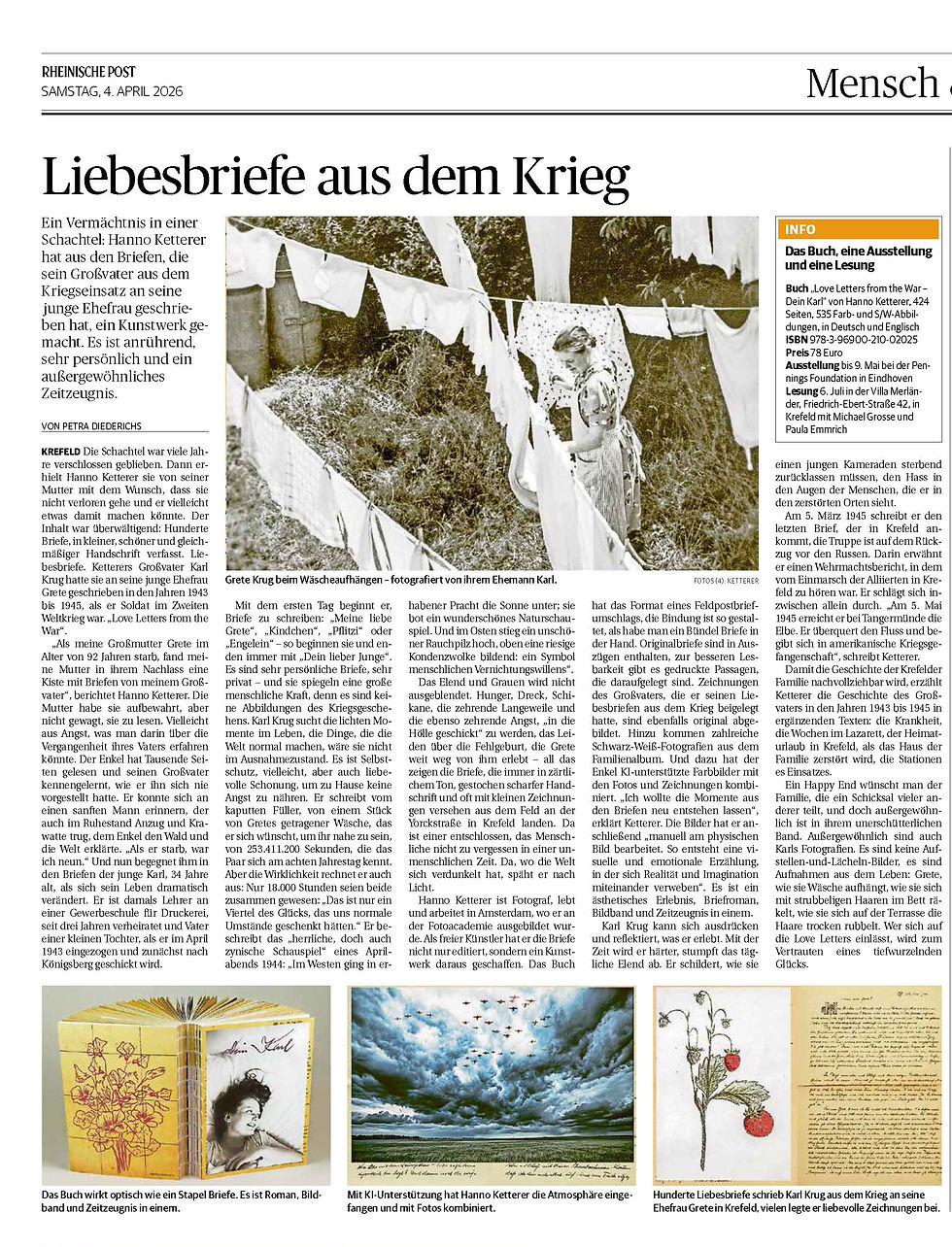
Rheinische Post, April 4 2026, Liebesbriefe aus dem Krieg, Hanno Ketterer, Fotobuch
Rheinische Post, April 4 2026, Liebesbriefe aus dem Krieg, Hanno Ketterer, Fotobuch
Apr 4, 2026
A legacy in a box: Hanno Ketterer has turned the letters that his grandfather wrote from military service to his young wife into a work of art. It is moving, very personal, and an extraordinary historical testimony.
Rheinische Post from April 4, 2026
Love Letters from the War
A legacy in a box: Hanno Ketterer has turned the letters that his grandfather wrote from military service to his young wife into a work of art. It is moving, very personal, and an extraordinary historical testimony.
KREFELD
The box had remained closed for many years. Then Hanno Ketterer received it from his mother with the wish that it should not be lost and that he might perhaps do something with it. The contents were overwhelming: hundreds of letters, written in small, beautiful, and even handwriting. Love letters. Ketterer’s grandfather Karl Krug had written them to his young wife Grete in the years 1943 to 1945, when he was a soldier in the Second World War. “Love Letters from the War.”
“When my grandmother Grete died at the age of 92, my mother found a box with letters from my grandfather in her estate,” reports Hanno Ketterer. His mother had kept them but had not dared to read them. Perhaps out of fear of what she might learn about her father’s past. The grandson read thousands of pages and got to know his grandfather as he had never imagined him. He could remember a gentle man who, even in retirement, wore a suit and tie and explained the forest and the world to his grandson. “When he died, I was nine.” And now, in the letters, he encounters the young Karl, 34 years old, at the moment when his life changes dramatically. At that time, he is a teacher at a vocational school for printing, has been married for three years, and is the father of a young daughter when he is drafted in April 1943 and initially sent to Königsberg.
From the first day on, he begins to write letters: “My dear Grete,” “little child,” “Pflitzi,” or “little angel” — this is how they begin, and they always end with “Your dear boy.” They are very personal letters, very private — and they reflect a great human strength, because they are not depictions of the events of war. Karl Krug searches for the bright moments in life, the things that would make the world normal if it were not in a state of exception. It is self-protection, perhaps, but also a loving act of sparing her, so as not to nurture fear at home. He writes about a broken fountain pen, about a piece of Grete’s worn clothing that he wishes for to feel close to her, about 253,411,200 seconds that the couple have known each other on their eighth anniversary. But he also calculates reality: only 18,000 hours have they spent together: “That is only a quarter of the happiness that normal circumstances would have given us.” He describes the “magnificent, yet also cynical spectacle” of an April evening in 1944: “In the west, the sun set in sublime splendour; it offered a beautiful natural spectacle. And in the east, an ugly mushroom of smoke rose, forming a huge condensation cloud at the top: a symbol of the human will to destroy.”
The misery and horror are not omitted. Hunger, dirt, harassment, the gnawing boredom and the equally gnawing fear of being “sent to hell,” the suffering over the miscarriage that Grete experiences far away from him — all of this is shown in the letters, which always arrive from the field at Yorckstraße in Krefeld in a tender tone, in precise handwriting, and often accompanied by small drawings. There is someone determined not to forget what is human in an inhuman time. Where the world has darkened, he searches for light.
Hanno Ketterer is a photographer, lives and works in Amsterdam, where he was trained at the Fotoacademie. As an independent artist, he has not only edited the letters but has created a work of art from them. The book has the format of a field-post envelope, the binding is designed as if one were holding a bundle of letters in one’s hands. Original letters are included in excerpts; for better readability, printed passages are laid over them. Drawings by the grandfather, which he had enclosed with his love letters from the war, are also reproduced in their original form. In addition, there are numerous black-and-white photographs from the family album. And alongside this, the grandson has combined AI-supported colour images with the photographs and drawings. “I wanted to let the moments from the letters come into being again,” explains Ketterer. He then “manually worked on the images on the physical print. In this way, a visual and emotional narrative emerges in which reality and imagination interweave.” It is an aesthetic experience, an epistolary novel, a photo book, and a historical testimony in one.
Karl Krug can express himself and reflects on what he experiences. Over time, he becomes harder, numbed by the daily misery. He describes how they must leave a young comrade behind to die, the hatred in the eyes of the people he sees in the destroyed places.
On March 5, 1945, he writes the last letter that arrives in Krefeld; the unit is retreating from the Russians. In it, he mentions a Wehrmacht report in which the entry of the Allies into Krefeld had been reported. By then, he is making his way on his own. “On May 5, 1945, he reaches the Elbe near Tangermünde. He crosses the river and surrenders into American captivity,” writes Ketterer.
So that the story of the Krefeld family can be followed, Ketterer recounts his grandfather’s story in the years 1943 to 1945 in accompanying texts: the illness, the weeks in the military hospital, the leave at home in Krefeld when the family house is destroyed, the stages of his deployment.
One wishes for a happy ending for the family, which shares a fate with many others, and yet is extraordinary in its unshakable bond. Karl’s photographs are also extraordinary. They are not posed, smiling pictures; they are images from life: Grete hanging laundry, stretching in bed with tousled hair, rubbing her hair dry on the terrace. Whoever engages with the Love Letters becomes a confidant of a deeply rooted happiness.
-----
INFO
The book, an exhibition and a reading
Book “Love Letters from the War” by Hanno Ketterer, 424 pages, 535 colour and black-and-white illustrations, in German and English
ISBN 978-3-96900-210-02025
Price 78 euros
Exhibition until 9 May at the Pennings Foundation in Eindhoven
Reading on 6 July at Villa Merländer, Friedrich-Ebert-Straße 42, in Krefeld with Michael Grosse and Paula Emmrich